
Beyond Trial Batches: Zero-Defect Granulation with Spatial Digital Twins
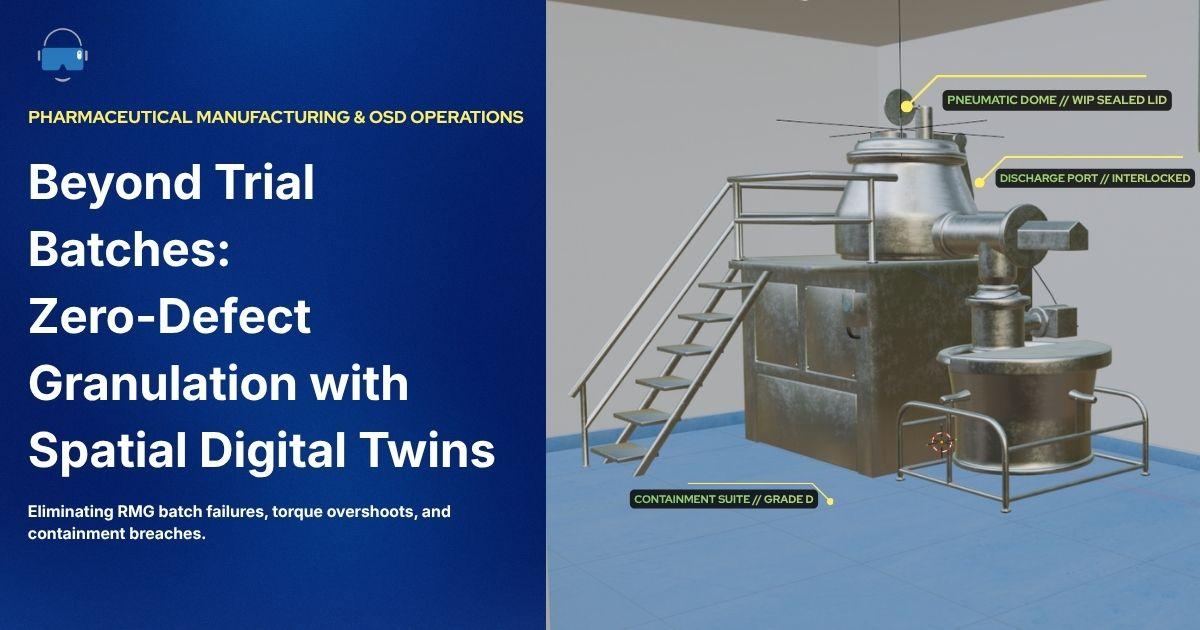
In oral solid dosage (OSD) manufacturing, high-shear wet granulation inside a Rapid Mixer Granulator (RMG) remains the most critical, unpredictable step in the entire production chain. A single misjudged endpoint, a 45-second overshoot on binder addition, or an unseated chopper seal can instantly scrap a $400,000 batch.
When powder turns to unrecoverable paste inside a 400-liter granulation bowl, it is rarely due to mechanical malfunction. The automated PLC executes its program, but process variations—excipient lot variability, binder viscosity shifts, or operator misinterpretation of motor torque resistance—create a thermodynamic runaway. By the time visual inspection confirms the doughing state, the active pharmaceutical ingredient (API) is ruined.
For decades, pharmaceutical companies have mitigated this risk with expensive trial batches, physical mock runs, and exhaustive Standard Operating Procedure (SOP) binders. Yet, human error during RMG charging, end-point verification, and cleaning validation remains among the leading root causes of FDA 483 inspection observations and batch rejection reports.
Spatial computing—merging high-fidelity Virtual Reality (VR) simulation with zero-friction WebXR digital twins—provides a scalable, validated alternative: enabling formulation and operations teams to qualify personnel and master high-shear kinetics in a risk-free 3D environment before burning live materials.
The Regulatory Mandate: EU GMP Annex 15 & FDA 21 CFR Part 211
Regulatory bodies no longer view classroom training as sufficient qualification for critical process steps. EU GMP Annex 15 (Qualification and Validation) explicitly requires demonstrable evidence that operators understand critical process parameters (CPPs) and critical quality attributes (CQAs). Concurrently, USFDA 21 CFR Part 211.25 mandates documented personnel training in specific operations, while ISPE GAMP 5 establishes risk-based validation frameworks for computer-driven training environments.
The Physics of RMG Batch Aborts: The 60-Second Inflection Window
High-shear wet granulation transforms fine, cohesive powders into uniform, free-flowing granules essential for consistent tablet compression and dissolution profiles. However, the process is notoriously nonlinear.
High-Shear Wet Granulation Phase Dynamics (0–12 Minutes)
Fluidizing excipients and API. Critical failure: incomplete blend uniformity (CV > 2%) resulting in fatal downstream content uniformity rejections.
Atomized binder spray introduction. Critical failure: localized over-wetting creating stubborn, non-dispersible lumps before shear can distribute moisture.
Capillary bonding and granule consolidation. Motor resistance rises non-linearly. The operator must listen for motor harmonics and track real-time torque slope.
The 60-Second Trap:Between 9:30 and 10:30, granules reach ideal bulk density. Overshooting by >45 seconds collapses porosity into an irreversible paste dough, aborting the batch.
Technical Architecture: Real-Time PAT Telemetry vs. Open-Loop Sampling
Traditional offline verification relies on manual sampling ports—opening the vessel lid or using sampling thieves that disrupt internal vacuum, introduce contamination risks, and introduce a 90-second measurement delay. In contrast, modern Process Analytical Technology (PAT) and spatial twins monitor real-time motor impedance.
Containment & Cross-Contamination: The OEB 4 / OEB 5 Challenge
The risk profile intensifies dramatically when manufacturing oncology, hormonal, or highly potent active pharmaceutical ingredients (HPAPIs). In suites classified under Occupational Exposure Band 4 (OEB 4: 1–10 µg/m³) or OEB 5 (<1 µg/m³), physical containment is a life-safety requirement.
Traditional onboarding cannot risk exposing new technicians to toxic powders inside a live cleanroom. Spatial computing isolates containment risks completely:
Split-Butterfly Valve Docking
Operators practice the exact mechanical docking, nitrogen purging, and alpha-beta flange alignment required when transferring HPAPI drums into the RMG charging dome. A loose seal or misaligned interlock triggers simulated airborne aerosolization alarms.
Cleaning-In-Place (CIP) Validation
FDA 483 warning letters frequently cite cross-contamination caused by residual powder behind chopper shaft seals and discharge gaskets. In WebXR, technicians strip down virtual impellers to inspect hidden dead-legs and spray-ball coverage maps before physical line clearance.
The Dual-Layer Architecture: Immersive VR vs. Browser-Based WebXR
Deploying spatial computing across a validated pharmaceutical site requires addressing the practical constraints of cleanroom gowning and strict IT governance. A single training methodology cannot fit every operational phase.
Deep Immersive Virtual Reality (VR)
Setting: Onshore training suites, engineering centers, or conference rooms outside the cleanroom barrier.
Purpose: Comprehensive operator qualification under EU GMP Annex 15. Technicians experience full-scale machine tear-downs, explosive runaway scenarios (ATEX/dust explosion protocols), and complex mechanical seal maintenance in fully interactive 6-DoF VR.
Zero-Install WebXR on Cleanroom Tablets
Setting: Cleanroom airlocks, gowning suites, and production corridors.
Purpose: Instant 3-minute pre-batch SOP refreshers. Delivered directly through standard web browsers on ATEX-certified, cleanroom-rated rugged tablets. Operators verify line clearances, valve alignments, and checklist protocols without removing sterile gloves or downloading unapproved software.
Operationalizing the STEP Framework for Pharmaceutical Manufacturing
GRAHAs VR applies its peer-reviewed STEP Framework (Story, Emotion, Place) to transform static standard operating procedures into permanent procedural memory:
1. Story (Deviation & Incident Context)
Instead of passively reading SOP-048, the operator steps into an active production deviation: the peristaltic binder pump pressure drops mid-granulation while the impeller is at full speed. The operator must execute root-cause diagnostic protocols before the batch reaches its irreversible over-massing limit.
2. Emotion (High-Consequence Accountability)
Simulations incorporate authentic cleanroom soundscapes—differential pressure alarms, acoustic motor pitches, and radio communications. Experiencing the consequence of an abort cultivates vigilance and accountability far deeper than a checkbox multiple-choice quiz.
3. Place (1:1 Millimeter-Accurate Digital Twins)
The digital environment is an exact digital replica of the operator's specific granulation suite—from the pneumatic dome clamps and HMI touchscreen layouts to the discharge butterfly valves. Spatial familiarity transfers directly to cleanroom hardware without cognitive friction.
The Business Case: Return on Investment for Plant Leadership
For Plant Heads, Chief Operating Officers, and Financial Controllers, spatial digital twins deliver immediate, quantifiable operational returns:
- Direct Elimination of API Scrap Costs:Preventing just one commercial batch abort per quarter saves between $150,000 and $600,000 in raw material loss and hazardous waste disposal fees.
- Reduction in Cleanroom Qualification Downtime:Qualifying a new granulation technician typically requires 40 to 60 hours of shadow training inside active Grade C/D suites, consuming valuable manufacturing capacity. Spatial twins offload 70% of operator training outside the sterile core.
- Audit-Proof Regulatory Defensibility:During FDA, EMA, or WHO GMP inspections, presenting auditable, time-stamped telemetry logs of operator spatial qualification demonstrates proactive quality-by-design (QbD) compliance that exceeds standard training logs.
Deploy Spatial Digital Twins Across Your OSD Manufacturing Lines
Discover how GRAHAs VR partners with pharmaceutical manufacturers and CDMOs to engineer millimeter-accurate cleanroom digital twins. Eliminate batch aborts, de-risk HPAPI containment, and accelerate GMP qualification.


Frequently Asked Questions
How does spatial computing prevent costly batch failures in Rapid Mixer Granulators (RMG)?
High-shear wet granulation operates within narrow thermodynamic and mechanical windows. Spatial digital twins replicate impeller-chopper torque dynamics, binder spray distribution patterns, and real-time resistance curves in a physics-accurate 3D environment. Operators learn to identify subtle motor sound profiles and torque inflection points before touching commercial Active Pharmaceutical Ingredients (APIs), preventing $150,000+ batch doughing aborts.
How do spatial digital twins satisfy EU GMP Annex 15 and FDA 21 CFR Part 211 validation standards?
EU GMP Annex 15 mandates rigorous operator qualification and process validation. Spatial digital twins provide tamper-evident, auditable telemetry tracking every operator action during simulated batch cycles, cleaning-in-place (CIP) inspections, and line clearance handovers. This satisfies FDA 21 CFR Part 211 requirements for reproducible personnel training and contamination control without burning live production batches.
Can spatial simulations help de-risk operator exposure to Highly Potent APIs (HPAPIs)?
Yes. When processing compounds rated Occupational Exposure Band 4 (OEB 4) or OEB 5 (<1 µg/m³), opening ports or mismanaging pneumatic discharge seals creates catastrophic containment breaches. Spatial twins allow operators to master split-butterfly valve docking, negative-pressure isolator transfers, and emergency seal leak containment in VR and WebXR with zero chemical exposure risk.
What is the deployment overhead of WebXR on validated pharmaceutical plant floors?
WebXR requires zero client installations, running directly inside standard web browsers on cleanroom-rated, ATEX-certified tablets. Technicians review 3-minute spatial line clearances and machine disassembly procedures directly at the suite threshold without breaking cleanroom gowning protocols or requiring IT firewall modifications.