
Human-Centric Innovation: Designing XR Workflows That Employees Actually Want to Adopt
June 16, 2026
The Enterprise Extended Reality (XR) space has reached a critical inflection point. The conversation is no longer about proving the technology works; it is about proving that a workforce will actually use it.
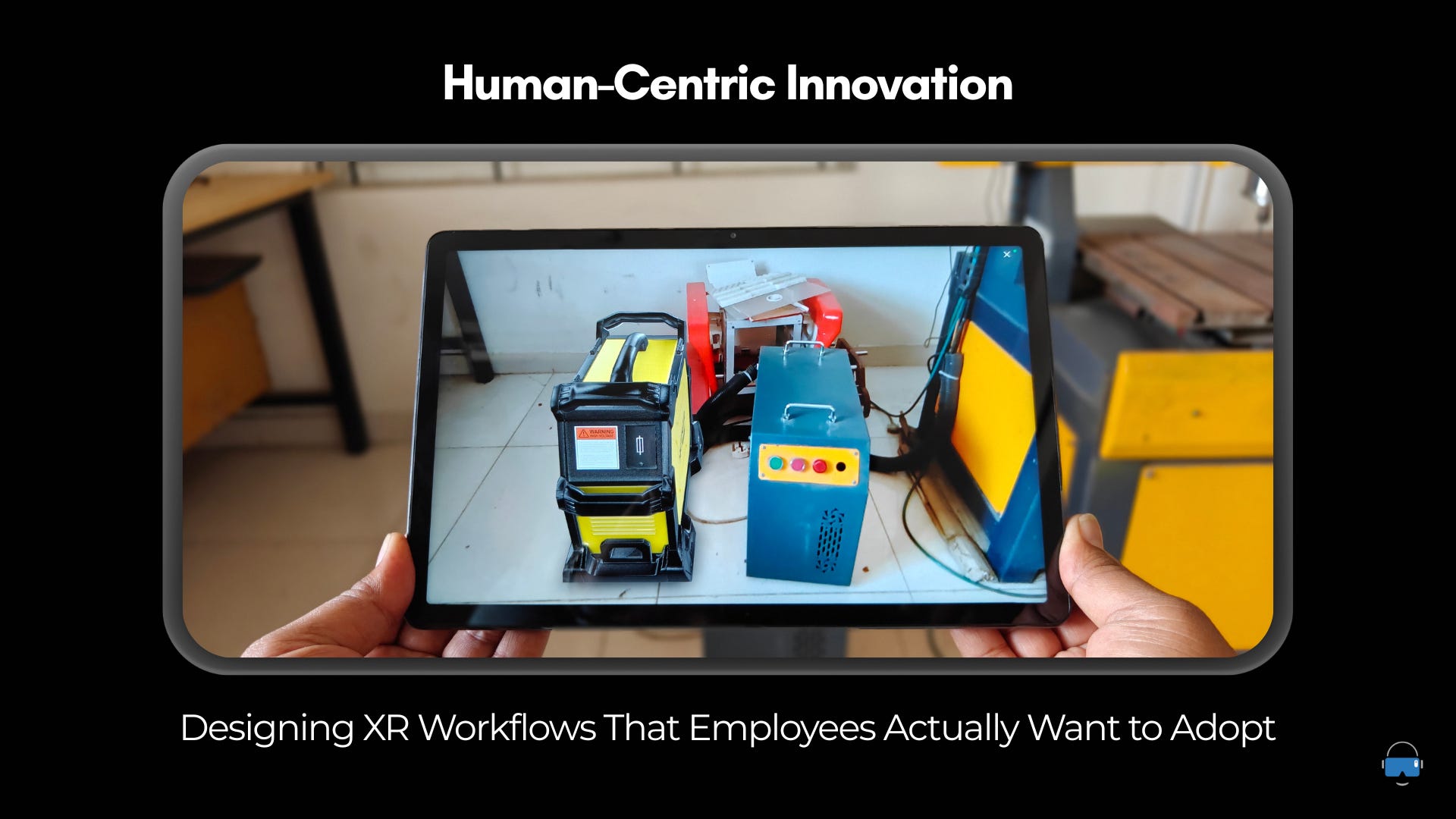
Organizations are investing heavily in spatial computing for training, onboarding, and digital twins, yet many find their initiatives stalling after the pilot phase. The root cause rarely lies in the rendering capabilities or the hardware. Instead, the bottleneck is human. When new technology introduces operational friction, employees inevitably revert to legacy workflows.
To scale spatial computing from the innovation lab to daily operations, the architecture of the experience must fundamentally prioritize the psychological and operational realities of the end-user.
Why do enterprise XR pilots fail?
Enterprise XR pilots typically fail because they prioritize hardware capabilities over user comfort. Poor ergonomics, app-download friction, and complex user interfaces lead to cognitive overload and immediate employee resistance. When a tool requires more effort to access than the problem it solves, adoption naturally collapses.
The Frictionless Imperative: Bypassing the App Store
The most human-centric workflow is one that requires zero new behaviors to access. Asking an employee or a client to download a massive application, navigate enterprise authentication on a personal device, or put on tethered hardware introduces immediate barriers.
True enterprise scaling requires zero-friction access. By merging enterprise-grade web infrastructure with advanced WebGL and WebXR APIs, it is now possible to bypass app stores entirely. High-fidelity 3D industrial models and complex augmented reality environments can be rendered seamlessly at 60FPS directly within a standard mobile browser.
When a design or a training module can be accessed simply by clicking a secure link or scanning a QR code, the technology fades into the background. The user moves from screen to reality instantly, focusing entirely on the task rather than the tool.
In the case of heavy VR Applications, where technical feasibility is challenging for Web XR implementation, features like the KIOSK Mode, Mobile Device Management (MDM) of VR Headsets play a pivotal role in alleviating the friction points.
Designing for the Brain: The STEP Framework
Overcoming resistance also requires rethinking how digital information is structured. XR development must be grounded in how the human brain natively processes information and learns.
The STEP Framework—comprising Story, Emotion, and Place—leverages core principles of cognitive psychology and neuroscience to build environments that reduce cognitive load:
Story (Narrative Learning): Abstract workflows and complex industrial procedures are difficult to memorize in isolation. Framing a process within a logical, narrative sequence gives the user a predictable path, making the information stick.
Emotion (Emotional Engagement): A sterile digital environment yields sterile results. By simulating realistic stakes and responsive scenarios, emotional engagement is triggered, which directly correlates to higher memory retention.
Place (Contextual Learning): Training someone on heavy machinery via a 2D manual creates a translation gap. Spatial learning allows the brain to map physical actions to a 1:1 scale environment, eliminating the need to mentally translate flat instructions into three-dimensional actions.
From Theory to Floor: Actionable ROI
When these human-centric principles are applied, the return on investment becomes highly measurable. Consider standard industrial applications like electrical safety, fire safety, or crane operation.
Relying on traditional manuals or passive video lectures often results in low engagement and poor retention. However, utilizing off-the-shelf, module-based XR platforms—such as Zeal X—transforms these standard procedures into interactive, spatial experiences. By prioritizing intuitive design and focused experiential learning, these industrial deployments have demonstrated 4 times faster and 4 times focused training compared to conventional methods.
Furthermore, as users become comfortable with pre-built modules, organizations can introduce self-serve authoring tools, empowering teams to create their own 3D content without needing a background in software development.
The Path Forward
The future of spatial computing in the enterprise is not going to be won by the heaviest headsets or the most complex feature sets. It will be won by workflows that respect the employee’s time and cognitive bandwidth.
By eliminating access barriers through browser-based delivery and structuring content around established psychological frameworks, organizations can stop forcing adoption and start facilitating it.
How do you increase XR adoption in enterprise training?
To increase XR adoption, organizations must eliminate operational friction by bypassing standalone apps and tethered hardware. Utilizing a WebXR architecture allows employees to access heavy 3D models and training simulations instantly via a secure browser link or QR code. Combining this zero-download access with cognitive-focused learning methodologies ensures employees focus on the training material, not the technology.
What is the STEP Framework in XR development?
The STEP Framework (Story, Emotion, & Place) is a methodology for developing Extended Reality (XR) content based on cognitive psychology and neuroscience. By grounding digital environments in narrative learning (Story), realistic stakes (Emotion), and 1:1 spatial context (Place), the framework significantly reduces cognitive load and accelerates knowledge retention in industrial and enterprise training.
Is it possible to deploy AR/VR experiences without an app?
Yes. Modern enterprise spatial computing utilizes hybrid full-stack architectures and WebGL/WebXR APIs to render high-fidelity 3D and AR environments directly within a mobile browser. Platforms utilizing this architecture can deliver complex industrial models at 60FPS to standard smartphones without requiring any app store downloads or installations.
How can companies scale XR content creation without in-house developers?
Companies can scale XR adoption by utilizing module-based platforms that offer off-the-shelf training content for standard procedures (such as fire safety or electrical compliance). Once a baseline is established, organizations can leverage self-serve content authoring tools to build proprietary 3D modules—similar to creating a presentation—without requiring specialized coding or software development skills.
Have an use case for a potential XR Implementation? Let’s Connect.
We recently launched our “GRAHAs VR Spaces - Channel Partner Program.”
We are looking for digital transformation consultants, tech veterans, and B2B software resellers who work with SMBs in manufacturing, engineering, and real estate. Your clients are tired of paying massive shipping fees to lug heavy machinery to trade shows, or struggling to show true-scale property layouts. You can now offer them a pocket-sized, WebAR industrial showroom.
You handle the relationship and close the deal. Our engineering team takes over and handles 100% of the 3D modeling, platform deployment, and hosting. Zero fulfillment headaches for you. Industry leading commissions and prompt payouts.
If you want to add a serious, enterprise-grade spatial computing solution to your portfolio (and unlock upsells into our custom XR and Zeal X modules), let's talk.
Become a GRAHAs VR Spaces - Channel Partner