
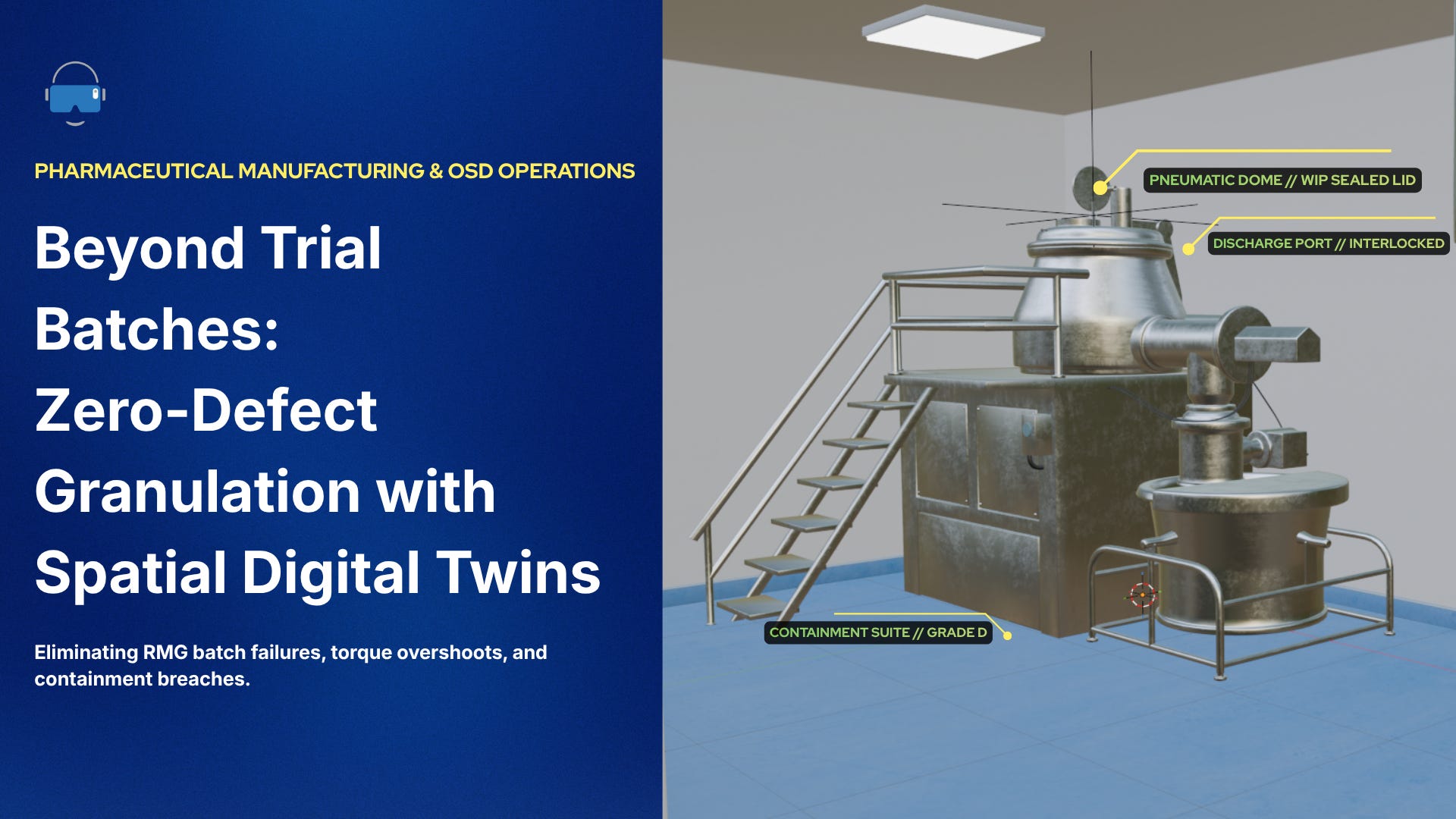
Beyond Trial Batches: Zero-Defect Granulation with Spatial Digital Twins
October 6, 2026
Originally published on the GRAHAs VR Insights Hub.
In Oral Solid Dosage (OSD) manufacturing, high-shear wet granulation inside a Rapid Mixer Granulator (RMG) is where commercial margins are made—or completely destroyed.
A 45-second overshoot on binder addition or a misread motor resistance curve doesn’t just trigger a minor deviation. It turns 400 liters of active pharmaceutical ingredient (API) into unrecoverable paste, scrapping a $150,000 to $600,000+ commercial batch.
The 60-Second Inflection Trap
Why does this happen despite validated PLCs and strict SOPs?
Because granulation kinetics are non-linear. During wet massing, powder transitions rapidly through distinct physical states: Pendular - Funicular - Capillary.
Traditional offline verification relies on manual sampling ports or “snowball” hand tests. By the time a technician pulls a sample to evaluate consistency, capillary liquid bridges have already saturated the blend. The torque curve spikes exponentially, collapsing granule porosity into an irreversible doughing state.
Furthermore, with oncology and highly potent compounds (HPAPIs rated OEB 4 / OEB 5), opening inspection ports or mismanaging pneumatic transfer seals introduces severe chemical exposure risks and cross-contamination hazards.
The Regulatory Shift: EU GMP Annex 15 & FDA 21 CFR 211
Regulatory bodies no longer accept classroom lectures or SOP sign-off sheets as defensible proof of operator qualification.
EU GMP Annex 15 explicitly mandates verifiable operator understanding of Critical Process Parameters (CPPs) and Critical Quality Attributes (CQAs). Concurrently, USFDA 21 CFR Part 211.25 and ISPE GAMP 5 require documented, reproducible training systems that prevent contamination and batch failures before commercial materials are introduced.
Bridging the Gap: Spatial Digital Twins
Spatial computing transitions pharmaceutical training from theoretical SOP reviews to high-fidelity, cognitive conditioning:
Acoustic & Torque Inflection Muscle Memory: In physics-accurate 1:1 digital twins, operators observe real-time resistance curves synchronized with 3D granule growth, learning to recognize motor harmonic shifts and torque slopes before touching live APIs.
Zero-Risk HPAPI Containment Mastery: Technicians practice split-butterfly valve docking, nitrogen purging, and Clean-In-Place (CIP) impeller tear-downs in virtual reality without chemical exposure risk.
Zero-Friction WebXR Cleanroom Access: Micro-procedural refreshers run directly in standard browsers on cleanroom-rated tablets—requiring zero software installations and zero IT firewall friction.
Read the Full Executive Engineering Brief
We have published an in-depth operational analysis on the GRAHAs VR platform examining the process physics, validation pathways, and ROI of spatial cleanroom twins.
In the full briefing, we unpack:
The Granulation Execution Gantt Chart: Step-by-step phase parameters (RPM, spray rate, torque limits) from 0 to 12 minutes.
The SCADA PAT Telemetry Dashboard: Real-time motor torque curves vs. traditional manual sampling lag.
The Plant Leadership ROI: Eliminating API scrap, slashing cleanroom qualification downtime, and building audit-proof defensibility.