
Beyond Rest Logs: Engineering Cognitive Alertness on Offshore Assets with Spatial Computing
September 9, 2026
On an offshore drilling installation, FPSO, or subsea support vessel, the most volatile operational risk is rarely mechanical failure.
It is the silent, unmeasured decay of human cognitive bandwidth during rotating 12-hour shifts.
Consider the reality of Day 12 on a 21-day tour. At 03:45, an operator misinterprets a secondary alarm on the console. The breakdown isn’t lack of training or willful neglect; it is neurobiological. Under chronic sleep debt, constant 75 dB noise floors, and circadian disruption, reaction latency spikes by up to 300%. The operator looks directly at an anomalous vector or pressure variance—yet fails to process its deviation.
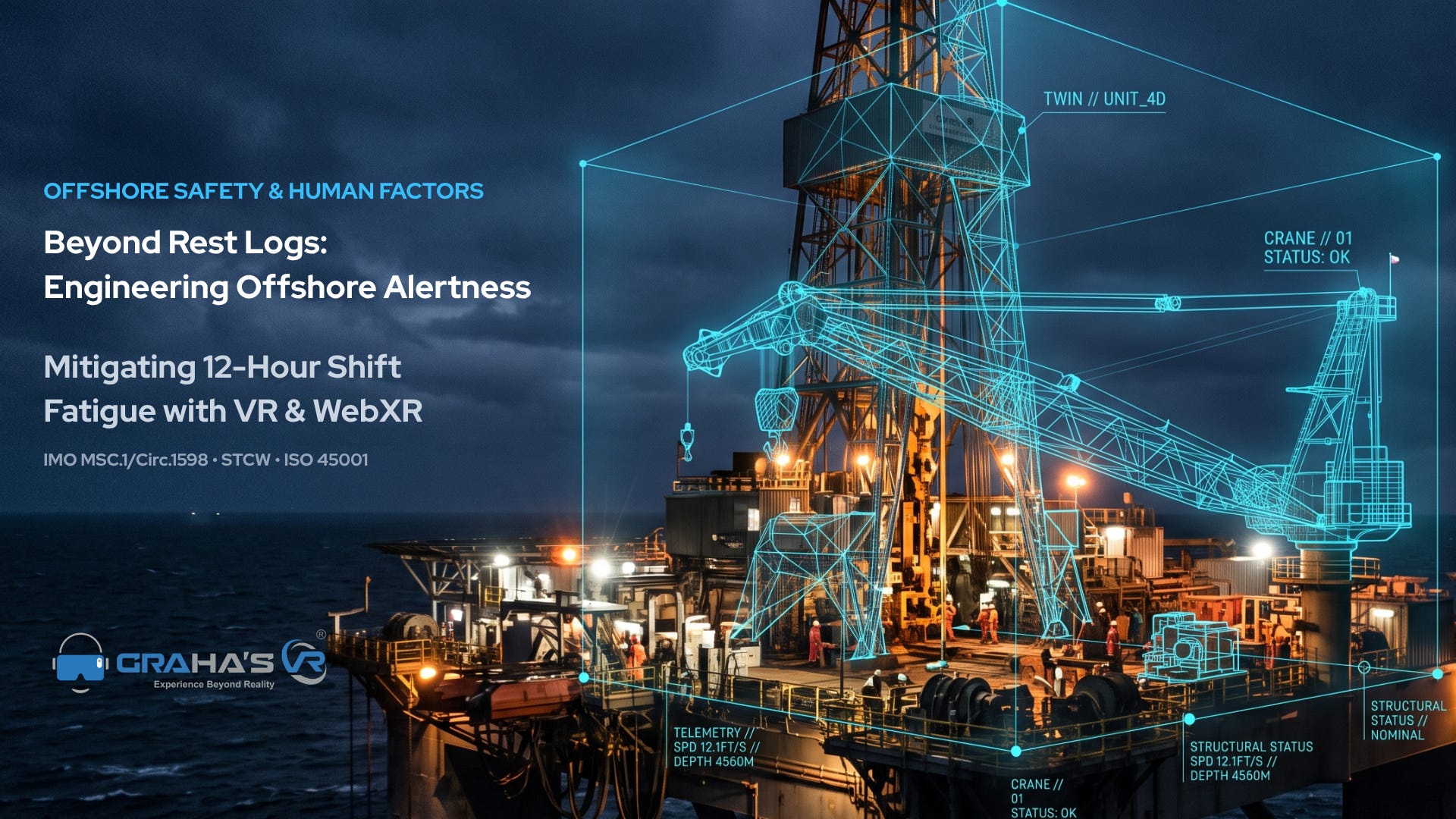
For decades, the energy and maritime sectors have attempted to mitigate this with retrospective paperwork: self-reported hours-of-rest spreadsheets and compliance logbooks.
The fundamental flaw? A logbook filed at 06:00 merely proves an operator was legally compliant on paper. It provides zero active protection on deck between 02:00 and 05:00 when cognitive tunneling and micro-lapses peak.
The Regulatory Shift: Closing the Paperwork Loophole
International regulators have already recognized this gap.
IMO MSC.1/Circ.1598 (Guidelines on Fatigue) explicitly mandates that safety management systems address the underlying operational causes of fatigue, not merely record rest hours. Simultaneously, STCW 2010 Manila Amendments and ISO 45001:2018 Clause 8.1.2 demand proactive engineering controls that verify crew fitness and situational awareness before safety-critical tasks commence.
If an incident occurs on deck and the investigation reveals fatigue-induced failure, presenting a clean rest-hour spreadsheet is no longer an adequate defense.
The Paradigm Shift: From Auditing Rest to Conditioning Alertness
This is where Spatial Computing fundamentally redefines Fatigue Risk Management Systems (FRMS).
Instead of passive slide decks or retrospective checkmarks, spatial computing merges high-fidelity Virtual Reality (VR) simulations with zero-install WebXR accessibility across rig-floor tablets and workstations:
Pre-Shift Cognitive Inoculation: Crews don’t just review a procedure; they run a 3-minute spatial drill of critical lift paths or valve alignments in an exact 1:1 digital twin during the pre-tour Toolbox Talk (TBT).
Stress Inoculation via the STEP Framework: Leveraging Story, Emotion, and Place, simulation replicates the auditory clutter, reduced visibility, and cognitive drag of late-shift operations, conditioning crews to actively identify their own reaction deceleration before stepping onto the steel deck.
Zero IT Friction: Modern WebXR executes locally inside standard browsers, operating within strict satellite bandwidth (VSAT) constraints without requiring unvetted client downloads on corporate networks.
Read the Full Operational Briefing
We have published an in-depth technical dossier on the GRAHAs VR platform examining the engineering and economic framework behind spatial fatigue management.
In the full briefing, we unpack:
The 12-Hour Circadian Telemetry Schematic: A visual analysis of cognitive bandwidth curves vs. incident windows.
The Business Case for OIMs & HSE Directors: Eliminating Non-Productive Time (NPT) and securing insurance underwriting advantages.
The IT & Bandwidth Architecture: Delivering 60 FPS simulations across offshore assets without software installation friction.
👉 Read the Full Executive Briefing on the GRAHAs VR Insights Hub